Doors & trim · 3 min read
Damaged floor transition strip? Match the two floors before buying a replacement
A cracked or lifting strip between rooms needs more than a close color match. The replacement must suit both adjoining floors, the difference in their heights and the way the strip attaches. First establish whether the trouble is the visible trim, its support or the flooring edges beside it.
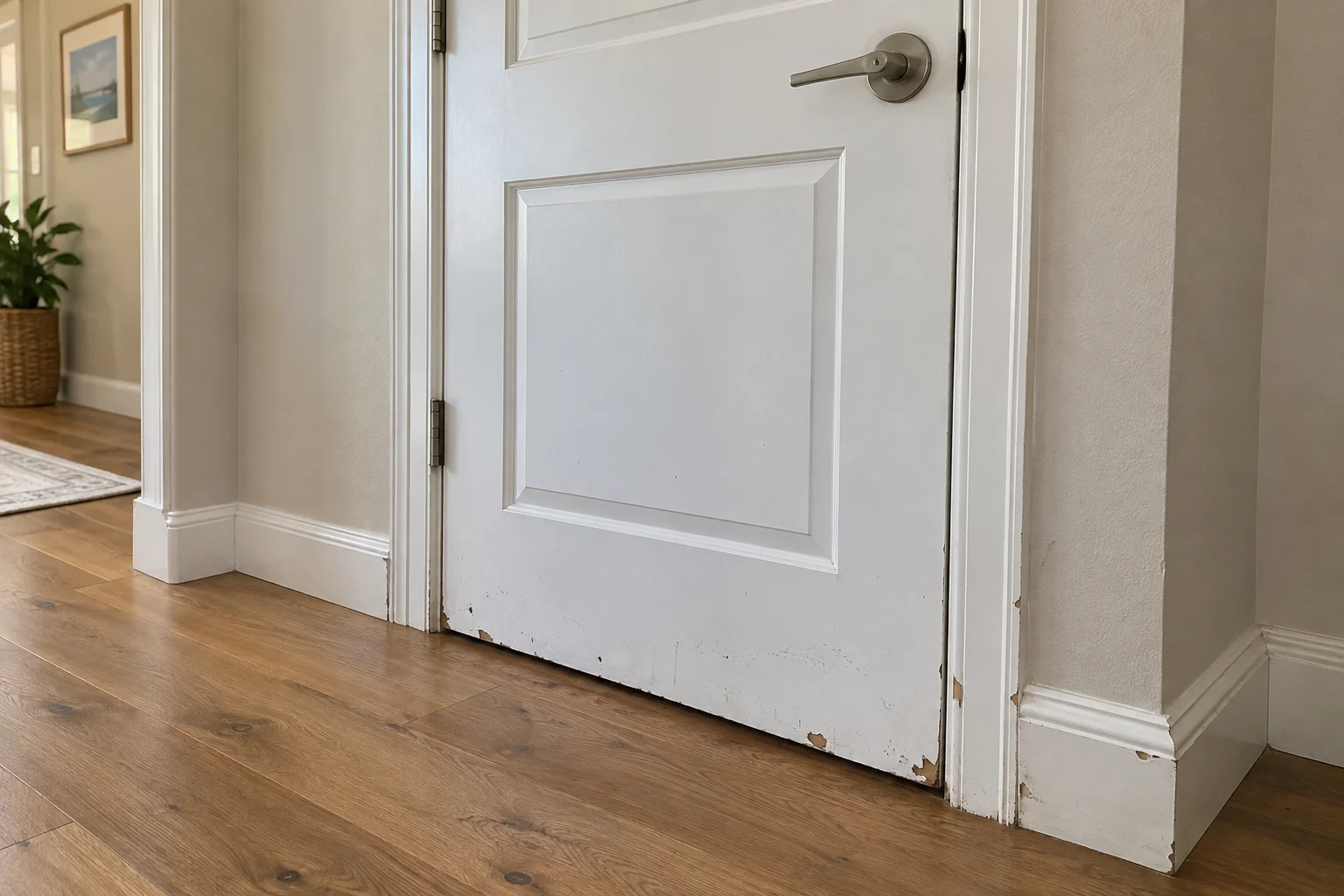
Describe the damage without pulling the strip up
Photograph the whole opening and the affected section from a safe position. Report what you have already noticed: a split top, a raised end, movement during normal use or chipping alongside it. Do not pry it off or repeatedly step on it to demonstrate looseness. Flag a raised or sharp edge so access can be addressed.
Ask the assessor to distinguish replacement of the visible strip from repair of its attachment or the adjoining floor. If flooring edges are loose, swollen or broken, covering them with a wider piece is not a diagnosis or an agreed repair.
Match the shape to the two surfaces
List the floor materials on each side and whether their finished surfaces appear level. Include flooring product details if you have them; leave precise fit measurements to the assessment.
- Similar heights: a T-molding may suit the junction. Versatrim specifies its T-molding for floors of approximately equal height.
- Different heights: ask about an appropriate reducer. Shaw distinguishes flush reducers for its nailed or glued hardwood installations from overlap reducers for floating installations.
- Existing hard-floor junction: a retrofit profile may be an option. Schluter RENO-T is designed for same-height hard surfaces and needs a suitable joint cavity and support at the adjoining edges.
Confirm the attachment system, not just the top piece
Versatrim's T-molding uses specified track and, for some floor thicknesses, shims. Its thickness definition includes the flooring assembly above the subfloor, not only the visible plank. An old track should therefore be checked for compatibility rather than assumed reusable because the new top looks similar.
Have the installer identify the required parts and whether the quote includes replacing damaged support. Send a previous order number or packaging label if available. Do not dismantle the floor to retrieve a product name.
Preserve movement and check the doorway
For its floating-hardwood overlap reducer, Shaw warns against attaching the reducer directly to the floating floor because that restricts expansion and contraction. Have the installer follow the instructions for your exact flooring and transition. There is no single gap measurement or attachment method that fits every junction.
Show where the closed door sits over the strip and report any existing scraping. Ask for clearance through the door's normal swing and normal closing to be checked with the proposed profile. A taller replacement may change that clearance; any door adjustment needs to be agreed separately.
Agree on the complete repair
Send Coast & Craft your city, opening photos, floor information and observed damage. Ask the proposal to identify the selected profile, attachment parts, any flooring-edge repair and the final doorway checks. The team must confirm whether it can accept the work or whether a flooring specialist is needed before arranging the visit.
Sources & product details
Manufacturer instructions for your exact product take precedence over general planning guidance.